Move the water. Keep the yard.
Foothill clay doesn’t drain, and a winter storm will find every low spot around your house. We build the system underneath — French drains, collection, piping, and grading — then put the landscape back on top so you never see it again.
- French Drains
- Surface-Water Collection
- Drain Piping
- Trenching & Excavation
- Backfill & Compaction
- Landscape Grading
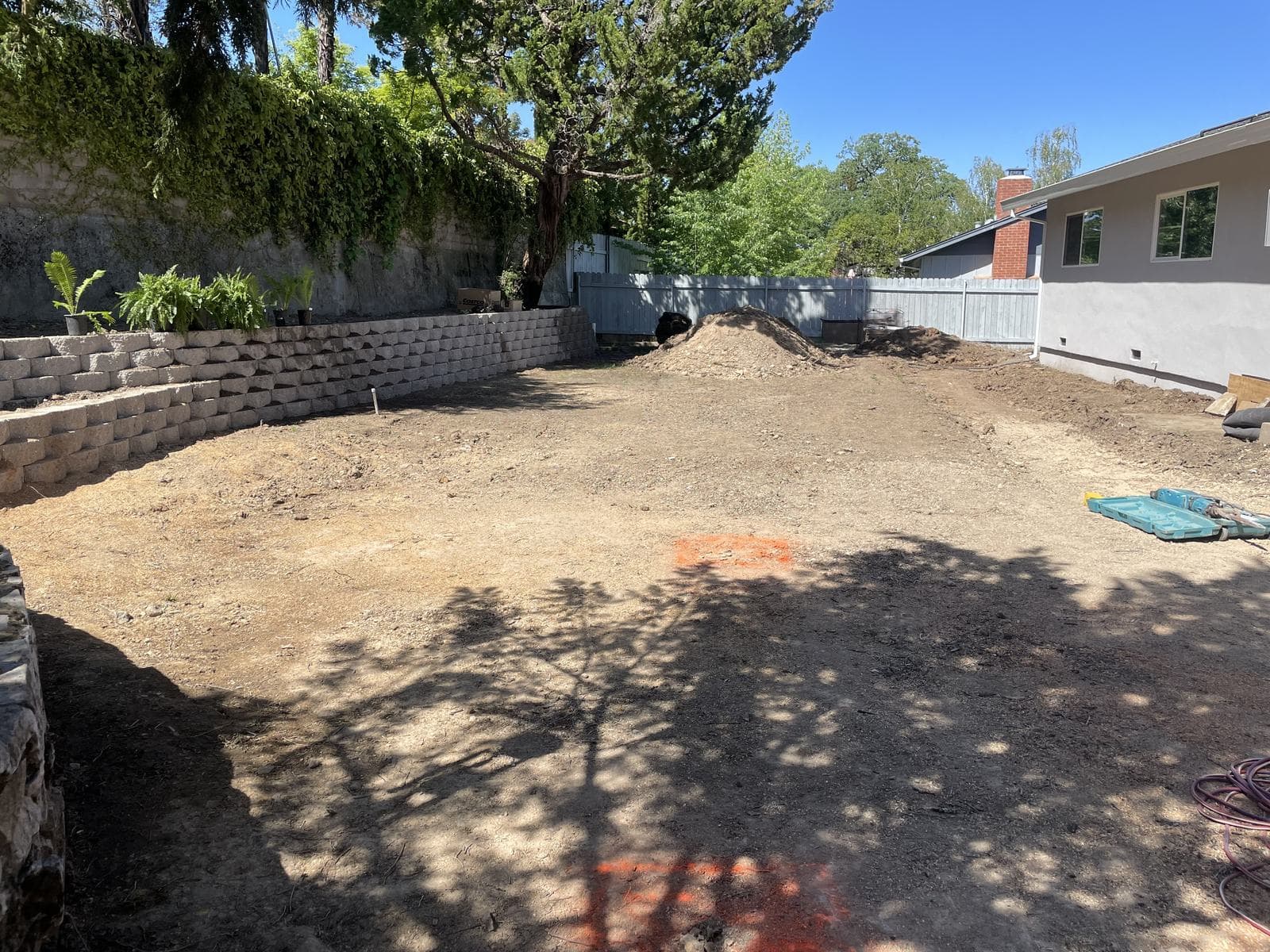
Every piece of the drainage system, one crew
Drainage fails at the handoffs — the digger who isn’t the grader, the grader who isn’t the landscaper. We do the whole run, from the first shovel to the finished lawn.
French Drains
A fabric-wrapped stone trench with perforated pipe that intercepts groundwater before it reaches your foundation, patio, or lawn.
- Foundation, hillside, and lawn interceptor drains
- Geotextile-wrapped, washed ¾-in. drain rock
- Finished with river rock or re-laid sod
Surface-Water Collection
Catch the water where it lands — at downspouts, low spots, and hardscape edges — and send it somewhere useful.
- Catch basins and channel / trench drains
- Downspout tie-ins with buried solid lines
- Dry creek beds and swales that look designed
Drain Piping
Solid pipe for conveyance, perforated pipe for collection, each laid to a steady fall so nothing sits and silts up.
- Smooth-wall solid and perforated drain lines
- Cleanouts at turns for future maintenance
- Daylight outlets, pop-up emitters, and dry wells
Trenching & Excavation
Machine trenching where there's room, careful hand digging where there are roots, utilities, or finished work to protect.
- 811 utility locate called before every dig
- Mini-excavator and trencher access for tight yards
- Hand excavation around mature tree roots
Backfill & Compaction
The part that decides whether a trench line sinks in a year. We backfill in lifts and compact each one.
- Compacted lifts — no settled trench scars
- Drain rock vs. native soil placed where each belongs
- Topsoil, sod, and planting restored on top
Landscape Grading
Most drainage problems are grading problems. We re-shape the ground so water leaves the house on its own.
- Positive slope away from foundations
- Swales and berms to steer sheet flow
- Laser-level checked, not eyeballed
Anatomy of a French drain that actually works
Most failed drains we dig up are missing one of these layers — usually the fabric or the slope. Here’s what goes in the ground on every job.
- 1Positive grade
Soil re-shaped to fall away from the foundation — code asks for 6 in. of drop in the first 10 ft.
- 2Finished cap
River rock or re-laid sod over the trench, so the drain disappears into the landscape.
- 3Filter fabric
Non-woven geotextile wraps the stone so fine silt can't migrate in and clog it.
- 4Washed drain rock
Clean ¾-in. stone. The voids between rocks are where the water actually travels.
- 5Perforated pipe
Holes down, laid at a steady fall of at least ⅛ in. per foot to a daylight outlet or dry well.
- 6Shaped trench floor
Undisturbed subgrade cut to a true slope, so the pipe never sags and holds standing water.
Your yard is telling you where the water goes
Water that sits against a foundation, undercuts a slope, or saturates the soil behind a wall does slow, expensive damage. Fixing the drainage is almost always cheaper than fixing what it ruins.
It also matters for the landscape: most plants that “mysteriously” die in a foothill yard drowned in heavy clay over the winter.
Have us walk your property →- Puddles that are still there a day after the rain stops
- Soggy lawn, moss, or mushrooms in the same spot every winter
- Mulch and soil washing onto the patio or driveway
- Gullies or bare channels cut into a slope
- Downspouts dumping right at the foundation
- Damp crawlspace, musty smell, or water stains on stem walls
- White crust (efflorescence) on block walls and steps
- A retaining wall that's leaning, bulging, or weeping at the base
From standing water to a dry yard in four steps
Walk the water
We look at where water comes from, where it pools, and where it can legally go — slope, soil, downspouts, and the neighbor's yard included.
Design the route
A drawn plan with pipe runs, fall, outlet, and grade changes, plus a fixed bid. Utilities are located through 811 before anything is cut.
Dig, lay & backfill
Trench to a true slope, set fabric, stone, and pipe, then backfill in compacted lifts. Roots, irrigation, and hardscape are protected along the way.
Flow-test & restore
We run water through every line before closing it up, then put the lawn, beds, and stone back so the work disappears.
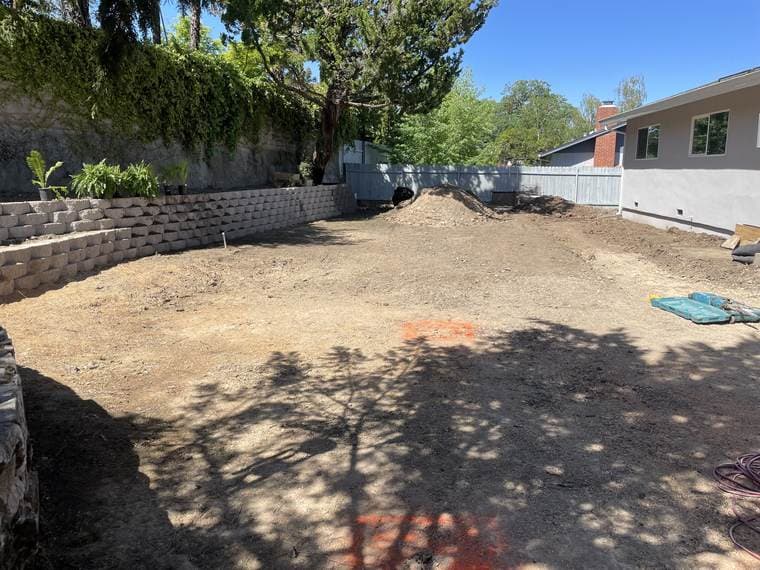
Drainage built by a landscaper, not just a digger
A trench crew can bury pipe. What they don’t do is plan the outlet around your future patio, keep the line out of the oak’s root zone, or re-grade the bed so it sheds water and still looks right. That’s the difference between a drain and a landscape that drains.
We pair drainage with the rest of the work — retaining walls, hardscape, irrigation, and planting — so it’s designed once and built once, instead of dug up again next year.
Drainage FAQ
Do I need a French drain or just better surface drainage?+
It depends on where the water is coming from. Water that runs across the surface — off the roof, the patio, or a slope — is usually solved with grading, catch basins, and solid drain lines. Water that comes up through saturated soil or seeps out of a hillside needs a subsurface drain. Many properties need both, and we'll tell you which after walking it.
Where does all the water go?+
Somewhere lower and legal: a daylight outlet on your own property, a dry well sized for the soil, a dry creek bed, or a curb outlet where the city allows it. We don't push your water onto a neighbor's lot.
Can you work around my mature trees?+
Yes. Near trees we route lines outside the critical root zone where we can and hand-dig where we can't, so we're not shearing the structural roots that keep the tree standing.
Will my lawn and garden be torn up?+
Temporarily. Sod is cut and set aside or replaced, beds are restored, and trench lines are compacted so they don't sink. Done right, the only sign we were there is that the water's gone.
When is the best time to fix drainage?+
Before the rainy season, ideally late summer through fall, when soil is workable and you can see results the first storm. If it's already pouring, we can still diagnose — standing water shows exactly where the problem is.
Get a free drainage & trenching bid
Tell us where the water collects and what it’s damaging. Photos or a video from the last storm help a lot — text them to us. We’ll walk the property and come back with a drawn plan and a fixed price.
Call or Text (279) 227-6372Prefer email? etelford32@gmail.com
Fix the water first. Then build something worth keeping dry.
Drainage pairs naturally with our other foothill work. Explore it, or open the design tool to see your yard thirty years out.